
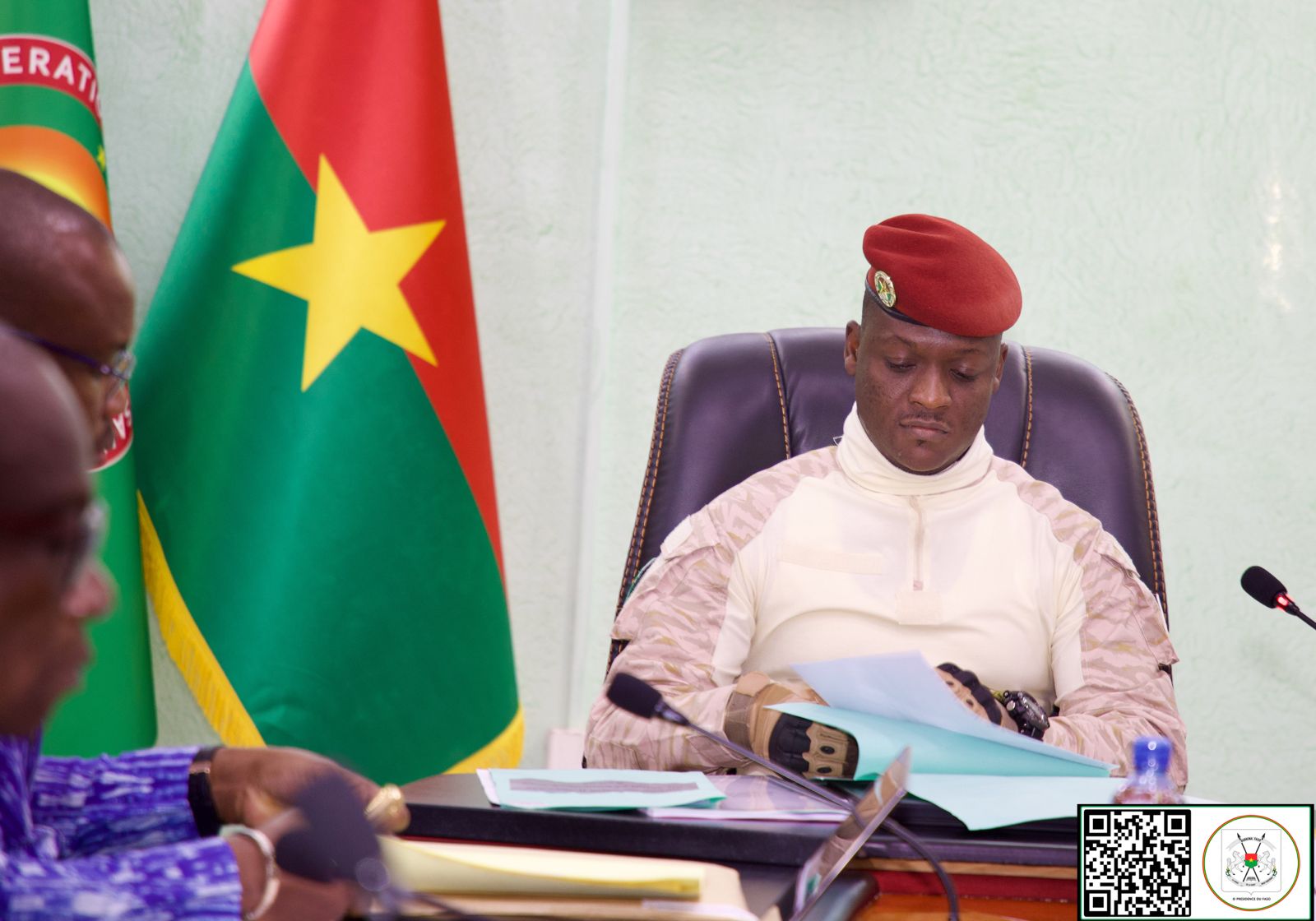
The Council of Ministers of Thursday, November 5, 2026, chaired by Captain Ibrahim Traoré, adopted four decrees under the Ministry of Industry, Commerce and Handicrafts. These texts create two new public structures, provide a framework for a mixed-economy company and dissolve a structure deemed less efficient.
The first decree creates a state-owned company called FASO SANU, whose mission is to clean up illegal artisanal and semi-mechanized gold mining.
The government justifies this creation by the proliferation of illegally occupied mining sites, conflicts of interest over certain perimeters and financial losses suffered by the State to the benefit of informal or criminal circuits.
FASO SANU will be responsible for pacifying mining conflict zones and securing the economic valuation of gold resources.
It will be 50% owned by the National Company for Precious Substances (SONASP) and 50% by the Public Treasury, making it a tool directly backed by the State for managing strategic sites.
This decision is part of a broader drive to formalize the artisanal mining sector. Burkina Faso’s regulatory framework already requires artisanal miners to organize into cooperatives and provides mechanisms for supervision, securing and marketing artisanal gold.
The second and third decrees concern the creation and statutes of TADJI DU FASO, also called TAFA Energies, a mixed-economy company. Its objective is to guarantee the availability, in quality and quantity, of petroleum products, particularly gas, whose occasional shortages have sometimes affected consumers.
This creation aims to consolidate recent gains in securing the supply chain and to reaffirm national sovereignty in a sector considered strategic.
SONABHY is authorized to take a stake in the capital of the new company, which strengthens the State’s role in the governance of the system.
The fourth decree dissolves the Société de gestion de l’équipement et de la maintenance biomédicale (SOGEMAB).
This decision responds to the government’s desire to rationalize the management of public structures and reduce institutional duplication.
SOGEMAB’s responsibilities are transferred to the Directorate of Infrastructure, Equipment and Maintenance (DIEM) of the Ministry of Health. This transfer aims to integrate biomedical equipment management directly into the health administration, for greater efficiency and consistency in monitoring hospital equipment.
These four decrees reflect a dual orientation of the government: strengthening the State’s presence in strategic sectors gold and hydrocarbons while simplifying the administrative apparatus where it is deemed redundant.
The creation of FASO SANU and TAFA Energies is in line with reforms aimed at better capturing the value of national resources and securing essential supplies.
The dissolution of SOGEMAB, meanwhile, illustrates the rationalization drive asserted by the authorities. By recentering competencies within the Ministry of Health, the government intends to improve the management of biomedical equipment without going through a dedicated external structure.
Daniel MBEKELE